Tuesday, March 19, 2013


Monday, March 18, 2013
Misguided Politician of the Week - VP Joe Biden
 |
| VP of the US, Joe Biden/AP Photo |
If you are both a citizen of the United States of America and Catholic, you should know that Vice President Joe Biden, a.k.a. 'Crazy Uncle Joe,' will be representing our nation at the upcoming Installation Mass of Pope Francis. Our Vice President reports that he is Catholic, but any honest person (Catholic or not) would admit that his Catholic identity is recognizable only when it is convenient.
Mr. Biden reportedly said that he looks forward to working with the new Pontiff on important issues in the future. It's too bad there is no indication the VP's future will be any different than his past. He'll be doing the 'Pelosi Shuffle' on Tuesday, St. Joseph's Day.
Just as other CINOs who went to Rome before, he'll jam an index finger into each ear and shout, "Yada, yada, yada I can't hear you Holy Father!" as the pope attempts to educate him. Pope Francis (Cardinal Bergoglio) on Catholic politicians:
“we should commit ourselves to ‘eucharistic coherence’, that is, we should be conscious that people cannot receive holy communion and at the same time act or speak against the commandments, in particular when abortion, euthanasia, and other serious crimes against life and family are facilitated. This responsibility applies particularly to legislators, governors, and health professionals"--Source

Wednesday, March 13, 2013
Pope Francis
 |
| Pope Benedict XVI greets Cardinal Bergoglio of Argentina |
Cardinal Bergoglio, now Pope Francis, is our first Jesuit Pope, and also the first from Latin America.
 |
| Greeting the faithful |
 |
| Blessing the faithful after humbly requesting that they pray for him. |
 |
| Good night and sleep well. |
His first words publicly spoken as Pope:
Brothers and sisters good evening.
You all know that the duty of the Conclave was to give a bishop to Rome. It seems that my brother Cardinals have come almost to the ends of the earth to get him… but here we are. I thank you for the welcome that has come from the diocesan community of Rome.
First of all I would say a prayer pray for our Bishop Emeritus Benedict XVI.. Let us all pray together for him, that the Lord bless him and Our Lady protect him.
Our Father…
Hail Mary…
Glory to the Father…
And now let us begin this journey, the Bishop and people, this journey of the Church of Rome which presides in charity over all the Churches, a journey of brotherhood in love, of mutual trust. Let us always pray for one another. Let us pray for the whole world that there might be a great sense of brotherhood . My hope is that this journey of the Church that we begin today, together with help of my Cardinal Vicar, be fruitful for the evangelization of this beautiful city.
And now I would like to give the blessing, but first I want to ask you a favour. Before the bishop blesses the people I ask that you would pray to the Lord to bless me – the prayer of the people for their Bishop. Let us say this prayer – your prayer for me – in silence.
[The Protodeacon announced that all those who received the blessing, either in person or by radio, television or by the new means of communication receive the plenary indulgence in the form established by the Church. He prayed that Almighty God protect and guard the Pope so that he may lead the Church for many years to come, and that he would grant peace to the Church throughout the world.]
[Immediately afterwards Pope Francis gave his first blessing Urbi et Orbi – To the City and to the World.]
I will now give my blessing to you and to the whole world, to all men and women of good will.
Brothers and sisters, I am leaving you. Thank you for your welcome. Pray for me and I will be with you again soon.
We will see one another soon.
Tomorrow I want to go to pray the Madonna, that she may protect Rome.
Good night and sleep well!
"Let's not be naive, we're not talking about a simple political battle; it is a destructive pretension against the plan of God," writes Bergoglio in a letter sent to the monasteries of Buenos Aires, where he is archbishop. "We are not talking about a mere bill, but rather a machination of the Father of Lies that seeks to confuse and deceive the children of God."-Source
On the sanctity of life:
“Those who think they own life are mistaken,” he said. “We should not think that because we have a little bit of power, we can monopolize or make ourselves the owners of life.”--Source
On dissenting politicians and the reception of communion:
“we should commit ourselves to ‘eucharistic coherence’, that is, we should be conscious that people cannot receive holy communion and at the same time act or speak against the commandments, in particular when abortion, euthanasia, and other serious crimes against life and family are facilitated. This responsibility applies particularly to legislators, governors, and health professionals"--Source
On the Year of Faith and the New Evangelization:
"We need to come out of ourselves and head for the periphery. We need to avoid the spiritual sickness of a Church that is wrapped up in its own world: when a Church becomes like this, it grows sick. It is true that going out onto the street implies the risk of accidents happening, as they would to any ordinary man or woman. But is the Church stays wrapped up in itself, it will age. And if I had to choose between a wounded Church that goes out onto the streets and a sick withdrawn Church, I would definitely choose the first one."--Source
Quoted St. Francis Prayer to children in 2010:
“where there is hatred, we will bring love, where there is fighting, we will bring peace.”--Source
Pope Francis' Schedule (EWTN News/CNA):
And now a word from my Bishop:
Tuesday, March 5, 2013
Readying for the Conclave
From CNA:
.- The College of Cardinals has agreed to hold a public prayer service on March 6 in St. Peter’s Basilica to pray for the upcoming conclave and the process of electing a new Pope.
“Since there is no afternoon meeting, tomorrow afternoon at 5:00 p.m. [Rome time] at the Altar of the Chair in St. Peter’s Basilica, the cardinals are inviting people to a time of adoration and Vespers,” Vatican press office director Father Federico Lombardi announced March 5.
Monday, February 25, 2013
Breaking: Conclave Rumored to Have Already Chosen Lesbian for Pope

I remember when I was a kid in the 1970s and woke up one morning to hear on the news that the pope had died. We watched on television as the conclave met, and celebrated the sight of white smoke spewing out of the chimney. Then just weeks later, I woke up to hear that the pope died.
"I know he died. Duh."
"No, the new one died."
"WHAT?!"
We all survived - well, except for the pontiffs who didn't. Please don't misunderstand, I don't underestimate the great love for Pope Benedict XVI that millions around the world have. I also have a realistic understanding of the aging process and know the limits of most people who are well into their eighties. He is doing what he believes to be best for our Church and has done some very remarkable things in the time he has served us as shepherd. I believe him when he says he reached the decision prayerfully. Give the man a break. And what a good man, fully human, he is.
What I find frustrating is the fact that so many feel called to weigh in on what the Church should and shouldn't do. It is bad enough when non-Catholics call for a more 'progressive' pontiff, or one who will allow priests to marry, females to become priests, gay men to be ordained, etc. - but then when fellow Catholics begin to opine similarly, it drives me batty! Add to this the uncertainty of individuals in the US who are currently without a Bishop and the people who seize upon the situation to undermine the Church, I completely shed all charitable thoughts and want to scream! What would I yell?
- If you aren't Catholic, mind your own business!
- If you are Catholic and think women should be ordained and/or: you believe the Church teachings on the gay lifestyle, abortion, artificial birth control, clown Masses, use of Latin in the Liturgy, the Eucharist, etc. are wrong - please leave. Stop your whining, take your self-righteous and condescending opinions and go. There are hundreds of options within 100 mile radius of just about anywhere in the lower 48 states. Buh bye. See ya!
- If you're Catholic and find yourself dipping into the realm of despair from time to time, adopt a cardinal. Pray. Trust. All shall be well.
Monday, June 28, 2010
Supreme Court allows sex abuse case against Vatican to proceed :: Catholic News Agency (CNA)
Washington D.C., Jun 28, 2010 / 12:12 pm (CNA/EWTN News).- Today the U.S. Supreme Court declined an immunity appeal by the Holy See in a case that attempts to sue the Vatican for transferring a priest accused of sexually abusing a minors several decades ago. The ruling by the Supreme Court allows the case to move forward.
An anonymous plaintiff from Oregon filed suit against the Vatican in 2002 after Fr. Andrew Ronan, an Irish priest with a history of sexually abusing minors, was transferred from Ireland to the U.S. and eventually moved to the Portland, Oregon. According to Reuters, Fr. Ronan died in 1992.
The plaintiff claims he was abused by Fr. Ronan several times in the mid 1960s and has filed suit against the Vatican, charging that the Catholic Church is responsible for transferring the priest and conspiring to cover up the allegations.
Jeffrey Lena, the U.S. attorney for the Vatican, has argued that the plaintiff has not provided evidence that the Vatican moved the priest or had control over him. Several U.S. bishops have also stated in the media that it is the local bishop who has control over priests, not the Vatican.
In a move to have a ruling by the 9th U.S. Circuit Court of Appeals vacated, the Holy See attempted to claim immunity under a U.S. Law – the Foreign Sovereign Immunities Act of 1976 – which helps prevent foreign states from being sued in court.
However, the appeals court cited exceptions to the law and charged that there was sufficient evidence that Fr. Ronan was an employee of the Vatican under Oregon law, thus allocating responsibility to the Holy See.
Another development in the case came in May when the U.S. Solicitor General’s office submitted an amicus curiae brief to the U.S. Supreme Court arguing that the 9th Circuit Court of Appeals misapplied the Sovereign Immunities Act.
The brief also claimed that the priest’s sexual abuse was also “not within the scope of the priest’s employment,” according to the solicitor general’s office, which advised the case be vacated and remanded back to the appellate court.
Despite these arguments, the U.S. Supreme Court allowed the 9th Circuit ruling to stand and declined to rule on the Vatican's immunity appeal. The decision by the nation's highest court was made without comment. The case will now proceed in U.S. District Court under the Oregon standards of employment.
Tuesday, October 20, 2009
Henry VIII Rolls Over in his Grave

Catchy title, isn't it? The above parchment, bearing 85 seals, is the Address of the Peers of England to Pope Clement VII asking for annulment of King Henry VIII's marriage. The King, as you recall, was seeking a divorce from his wife, Catherine of Aragon so that he could marry a lady-in-waiting, Anne Boleyn. The Pope then declared legitimate Henry VIII’s marriage with Catherine of Aragon, and therefore indissoluble. Hindered from carrying out his plans, the King got married again and declared the separation of the Church of England from the Church of Rome.
On October 20, 2009 the Congregation for the Doctrine of the Faith released the following:
NOTE OF THE CONGREGATION FOR THE DOCTRINE OF THE FAITH ABOUT PERSONAL ORDINARIATES FOR ANGLICANS ENTERING THE CATHOLIC CHURCHThe Archbishops of Westminster and Canterbury respond to the news with the following:With the preparation of an Apostolic Constitution, the Catholic Church is responding to the many requests that have been submitted to the Holy See from groups of Anglican clergy and faithful in different parts of the world who wish to enter into full visible communion.
In this Apostolic Constitution the Holy Father has introduced a canonical structure that provides for such corporate reunion by establishing Personal Ordinariates, which will allow former Anglicans to enter full communion with the Catholic Church while preserving elements of the distinctive Anglican spiritual and liturgical patrimony. Under the terms of the Apostolic Constitution, pastoral oversight and guidance will be provided for groups of former Anglicans through a Personal Ordinariate, whose Ordinary will usually be appointed from among former Anglican clergy.
The forthcoming Apostolic Constitution provides a reasonable and even necessary response to a world-wide phenomenon, by offering a single canonical model for the universal Church which is adaptable to various local situations and equitable to former Anglicans in its universal application. It provides for the ordination as Catholic priests of married former Anglican clergy. Historical and ecumenical reasons preclude the ordination of married men as bishops in both the Catholic and Orthodox Churches. The Constitution therefore stipulates that the Ordinary can be either a priest or an unmarried bishop. The seminarians in the Ordinariate are to be prepared alongside other Catholic seminarians, though the Ordinariate may establish a house of formation to address the particular needs of formation in the Anglican patrimony. In this way, the Apostolic Constitution seeks to balance on the one hand the concern to preserve the worthy Anglican liturgical and spiritual patrimony and, on the other hand, the concern that these groups and their clergy will be integrated into the Catholic Church.
Cardinal William Levada, Prefect of the Congregation for the Doctrine of the Faith which has prepared this provision, said: "We have been trying to meet the requests for full communion that have come to us from Anglicans in different parts of the world in recent years in a uniform and equitable way. With this proposal the Church wants to respond to the legitimate aspirations of these Anglican groups for full and visible unity with the Bishop of Rome, successor of St. Peter."
These Personal Ordinariates will be formed, as needed, in consultation with local Conferences of Bishops, and their structure will be similar in some ways to that of the Military Ordinariates which have been established in most countries to provide pastoral care for the members of the armed forces and their dependents throughout the world. "Those Anglicans who have approached the Holy See have made clear their desire for full, visible unity in the one, holy, catholic and apostolic Church. At the same time, they have told us of the importance of their Anglican traditions of spirituality and worship for their faith journey," Cardinal Levada said.
The provision of this new structure is consistent with the commitment to ecumenical dialogue, which continues to be a priority for the Catholic Church, particularly through the efforts of the Pontifical Council for the Promotion of Christian Unity. "The initiative has come from a number of different groups of Anglicans," Cardinal Levada went on to say: "They have declared that they share the common Catholic faith as it is expressed in the Catechism of the Catholic Church and accept the Petrine ministry as something Christ willed for the Church. For them, the time has come to express this implicit unity in the visible form of full communion."
According to Levada: "It is the hope of the Holy Father, Pope Benedict XVI, that the Anglican clergy and faithful who desire union with the Catholic Church will find in this canonical structure the opportunity to preserve those Anglican traditions precious to them and consistent with the Catholic faith. Insofar as these traditions express in a distinctive way the faith that is held in common, they are a gift to be shared in the wider Church. The unity of the Church does not require a uniformity that ignores cultural diversity, as the history of Christianity shows. Moreover, the many diverse traditions present in the Catholic Church today are all rooted in the principle articulated by St. Paul in his letter to the Ephesians: ‘There is one Lord, one faith, one baptism’ (4:5). Our communion is therefore strengthened by such legitimate diversity, and so we are happy that these men and women bring with them their particular contributions to our common life of faith."
Background information
Since the sixteenth century, when King Henry VIII declared the Church in England independent of Papal Authority, the Church of England has created its own doctrinal confessions, liturgical books, and pastoral practices, often incorporating ideas from the Reformation on the European continent. The expansion of the British Empire, together with Anglican missionary work, eventually gave rise to a world-wide Anglican Communion.
Throughout the more than 450 years of its history the question of the reunification of Anglicans and Catholics has never been far from mind. In the mid-nineteenth century the Oxford Movement (in England) saw a rekindling of interest in the Catholic aspects of Anglicanism. In the early twentieth century Cardinal Mercier of Belgium entered into well publicized conversations with Anglicans to explore the possibility of union with the Catholic Church under the banner of an Anglicanism "reunited but not absorbed".
At the Second Vatican Council hope for union was further nourished when the Decree on Ecumenism (n. 13), referring to communions separated from the Catholic Church at the time of the Reformation, stated that: "Among those in which Catholic traditions and institutions in part continue to exist, the Anglican Communion occupies a special place."
Since the Council, Anglican-Roman Catholic relations have created a much improved climate of mutual understanding and cooperation. The Anglican-Roman Catholic International Commission (ARCIC) produced a series of doctrinal statements over the years in the hope of creating the basis for full and visible unity. For many in both communions, the ARCIC statements provided a vehicle in which a common expression of faith could be recognized. It is in this framework that this new provision should be seen.
In the years since the Council, some Anglicans have abandoned the tradition of conferring Holy Orders only on men by calling women to the priesthood and the episcopacy. More recently, some segments of the Anglican Communion have departed from the common biblical teaching on human sexuality—already clearly stated in the ARCIC document "Life in Christ"—by the ordination of openly homosexual clergy and the blessing of homosexual partnerships. At the same time, as the Anglican Communion faces these new and difficult challenges, the Catholic Church remains fully committed to continuing ecumenical engagement with the Anglican Communion, particularly through the efforts of the Pontifical Council for the Promotion of Christian Unity.
In the meantime, many individual Anglicans have entered into full communion with the Catholic Church. Sometimes there have been groups of Anglicans who have entered while preserving some "corporate" structure. Examples of this include, the Anglican diocese of Amritsar in India, and some individual parishes in the United States which maintained an Anglican identity when entering the Catholic Church under a "pastoral provision" adopted by the Congregation for the Doctrine of the Faith and approved by Pope John Paul II in 1982. In these cases, the Catholic Church has frequently dispensed from the requirement of celibacy to allow those married Anglican clergy who desire to continue ministerial service as Catholic priests to be ordained in the Catholic Church.
In the light of these developments, the Personal Ordinariates established by the Apostolic Constitution can be seen as another step toward the realization the aspiration for full, visible union in the Church of Christ, one of the principal goals of the ecumenical movement.
Today’s announcement of the Apostolic Constitution is a response by Pope Benedict XVI to a number of requests over the past few years to the Holy See from groups of Anglicans who wish to enter into full visible communion with the Roman Catholic Church, and are willing to declare that they share a common Catholic faith and accept the Petrine ministry as willed by Christ for his Church.
Pope Benedict XVI has approved, within the Apostolic Constitution, a canonical structure that provides for Personal Ordinariates, which will allow former Anglicans to enter full communion with the Catholic Church while preserving elements of distinctive Anglican spiritual patrimony.
The announcement of this Apostolic Constitution brings to an end a period of uncertainty for such groups who have nurtured hopes of new ways of embracing unity with the Catholic Church. It will now be up to those who have made requests to the Holy See to respond to the Apostolic Constitution.
The Apostolic Constitution is further recognition of the substantial overlap in faith, doctrine and spirituality between the Catholic Church and the Anglican tradition. Without the dialogues of the past forty years, this recognition would not have been possible, nor would hopes for full visible unity have been nurtured. In this sense, this Apostolic Constitution is one consequence of ecumenical dialogue between the Catholic Church and the Anglican Communion.
The on-going official dialogue between the Catholic Church and the Anglican Communion provides the basis for our continuing cooperation. The Anglican Roman Catholic International Commission (ARCIC) and International Anglican Roman Catholic Commission for Unity and Mission (IARCCUM) agreements make clear the path we will follow together.
With God’s grace and prayer we are determined that our on-going mutual commitment and consultation on these and other matters should continue to be strengthened. Locally, in the spirit of IARCCUM, we look forward to building on the pattern of shared meetings between the Catholic Bishops Conference of England and Wales and the Church of England’s House of Bishops with a focus on our common mission. Joint days of reflection and prayer were begun in Leeds in 2006 and continued in Lambeth in 2008, and further meetings are in preparation. This close cooperation will continue as we grow together in unity and mission, in witness to the Gospel in our country, and in the Church at large.
London, 20 October 2009
Imagine -- the Queen of England being welcomed into full communion with the Catholic Church. As she is advancing in years, I can only imagine how difficult it may be to find a successor who was not divorced after a Sacramental marriage.

Monday, July 6, 2009
Looking Back at 1962: Pre-Vatican Council

I have a stack of old Catholic periodicals and came across this fascinating issue of VIEW: Catholic Comment on the News which is buzzing with talk of a possible change to using the vernacular in the Mass and speculating about other things which may come from the upcoming Vatican Council. Much of what is discussed continues to be discussed nearly fifty years later. New translation of the Mass, hints at ecumenism, Latin v. English -- it is all there. Following are letters of opinion sent to VIEW: Catholic Comment on the News by individuals representing other Catholic publications:
The Holy See is being petitioned from many quarters to allow greater use of the vernacular in the Mass. The obvious advantage of such a change would be a better understanding of the Liturgy. the whole idea is strongly opposed by some authorities on practical grounds. But polls show that a majority would welcome the change. The question is sure to receive attention of the coming Vatican Council. What the Council decides will be the Council's best judgment of what is best for the faithful.
What is the case for the use of the vernacular -- English for us -- in the sacred ceremonies and liturgy of the Church?
I feel that the main point in any discussion of replacing Latin with the common tongue of the country involved is this: God understands any language, but His people do not.
Prayer should be a lifting of the mind and heart to God, not a mechanical recitation. How can prayers said in a foreign language, learned by rote, be meaningful?
Our liturgy is not only the praise of God but out most important time of public worship and instruction. It is, moreover, a corporate action in which the people are to unite with the priest. This being true, the use of Latin in our parish liturgy is a considerable stumbling block. The blunt fact is that the overwhelming majority in the ordinary American parish do not know Latin and never will. Our Catholic family is not an educated elite. It is a vast number that includes millions of people who read very little -- certainly not Latin -- and whose principal contact with religion is the Sunday Mass.
Dare we close off that contact , dry up that instruction, make worship a difficult and remote business of fulfilling an obligation, instead of a vigorous, joyful experience, engaging the mind and heart and eye and ear -- the whole man caught up in the whole Christ, praising and adoring Father?
Rev. Joseph T. Nolan
Information
New York, N.Y.
FROM HEART AND MIND
Certainly the congregation no less than the altar boys can learn to make the responses. They could also learn to respond in Chinese in the same fashion and understand the responses no better. Granted that people can get 'some general notions' about what they say or sing, our prayer-life ought not to be something general or vague, something 'seen under water' as one man puts it. Every bit of it should flow from the heart and mind alike.
John L. Murphy
Homiletic and Pastoral Review
New York, N.Y.
UNITY AT MASS
Why all the pros and cons on changing our Latin Mass to English? Let's face the facts. The Church began to use the Latin language at a time when it was practically the only language spoken. They were a lot more reasonable than we are today. Now what language is spoken throughout America? English. I firmly believe every country should change their Mass to whatever language is spoken throughout that country.
Let's not think of ourselves -- born Catholics or converted Catholics. That is selfish. Let's think of our non-Catholic friends who attend Catholic weddings, funerals, dedications and Sunday Masses. They come away from the Church very confused. How many of us can actually come in contact with every one of these people to explain everything? The Mass can be a lesson or instruction to these non-Catholic friends who cannot come or do not want to come to instructions on Catholic religion.
To you who want to stick to the old Latin language: do you drive a chariot? Ninety-nine percent of you are driving new cars, keeping up with the latest styles, modern appliances.
How much unity do we have in our Church when the leader finishes the Gospel in English and the priest is still saying it in Latin? Often, when using the missal, seven or eight pages of silence pass by. For the ones without a missal, a million and one thoughts can go through a person's mind. Some of the time the priest is at the Lord's Prayer, and I've got a couple more pages to go, or some priests read slower, and I'm waiting for the Lord's Prayer. Is that praying in unity? Why have a leader who is the middle man between us and the priest. Let's only have the priest and us, worshipping God together.
Mrs. C. J. Ellsworth
The Oklahoma Courier
Oklahoma City, Okla.
LATIN NOT UNIVERSAL
Latin is the liturgical language of the Latin Rite of the Universal Church. It is not the liturgical language of the Greek Rite, or the Coptic Rite, or the Rumanian Rite.
There are about a dozen tongues used in the liturgy in the various rites of the Church. In every case, those tongues were selected, in the beginning, because they were the tongues of the people in one area or another.
The liturgy in the Western Church, originally Greek, was translated into Latin because the people spoke Latin. It remained in Latin long after the people had ceased to speak Latin and were speaking other tongues.
Catholic Universe Bulletin
Cleveland, Ohio
DISGRUNTLED?
A reader informs me that he will 'begin to have serious doubts about my intelligence' if I do not agree with an article opposing English in the dialog Mass written by Father R. F. Venti and published in the Northern Ontario Register.
Of course, I do not agree with Father Venti, because I think that more use of native tongues in the liturgy would help to bring millions back to the practice of the Faith, and to give the Faith to other millions.
As to having my intelligence doubted, I haven't the slightest objection to that. I hold it in low esteem myself. But my intelligence is not the point at issue; we are discussing English in the Mass.
I disagree with Father Venti on that; but I disagree much more with what he has to say about those who favor English, and with what he reads into what I have written on the subject.
He says that 'one gets the idea' from my columns that 'all Catholics are disgruntled, dissatisfied and disobedient, and that the Mass in Latin as we recite it in our churches is a batch of confusion.'
Never once have I said or suggested that anybody (much less "all Catholics") are disgruntled or disobedient. I have said that many Catholics would prefer English to Latin; if that is being 'dissatisfied,' then they are dissatisfied.
It is sometimes better to be dissatisfied than complacent. but I reject the terms 'disgruntled' and disobedient.' Nobody is disgruntled; and I assert that to ask for English in the Mass is not disobedience. It is obedience.
Pope John has urged us to ask for what we want. He went out of his way to tell lay people to voice their 'expectations and suggestions' for his coming world council, and 'not to doubt that they will find in us a benevolent hearing.'
Joseph Breig
Hawaii Catholic Herald
Honolulu
SPOOF
I know that a translation of our English Bible into Latin would exhilarate those who want to retain Latin in our Roman Catholic liturgy. Some of my priest friends who are Latinists have informed me that Latin is God's own language and, they are shocked if you suggest that the Apostles might have spoken Greek or Hebrew.
Let me tell you (with tongue securely in cheek) some of the wonderful ramifications that would develop from this project for the Bible in Latin. The daily missal for the laity would no longer be published in English but in Latin. The pamphlets on the rack in the rear of the church would be sold neatly packaged -- each pamphlet with its interliner trot in cellophane wrapper.
Latinists claim that Latin gives an air of mystery to the liturgy, so the Sunday sermon likewise, in Latin, could mystify the congregation. In some of our New York parishes it is said that Latin Americans feel ill at ease during the English sermons. So here we would have Latin sermons made-to-order for the latin Americans.
Buried forever would be the controversy over who first gave the Bible to the people in the vernacular -- the Catholics or Luther. The whole concept of a Bible in the vernacular would be a thing of the past. The Word of God would rest undisturbed by the prying eyes of readers who would dare to try to understand God's message to the world.
Rev. John B. Sheerin, C.S.P.
The Catholic Light
Scranton, Pa.
CONVERSATION PIECE
How would the Mass sound in English? You can find out if you live in the Cincinati area. Father Theodore H. Rolfes, S.J., an assistant at St. Xavier's Church, offers a demonstration of the Mass in English and he's looking for opportunities to bring it before parish societies and other Catholic organizations.
Father Rolfes doesn't present his program as a novelty, though it is novel. His primary interest is to stiumlate interest in the true meaning of the Holy Sacrifice of the Mass. He is convinced, moreover, that if the Holy See extends permission for use fo the language of the people in the Mass, their understanding will be enlarged considerably. But how will ordinary people form intelligent opinion of the worth of English in the liturgy without hearing it?
As Father Rolfes prepares the chalice and its coverings he outlines their uses. An acolyte, meanwhile, puts on cassock and surplice; on the occasion when I was present the acolyte was Charles Brosey, an A. T. and T. supervisor who resides in the St. Vivian's Parish.
Forth they went together, Father Rolfes and Mr. Brosey. After the priest made the sign of the cross in English he began the prayers at the foot of the 'altar.'
"I will go unto the alter of God."
"To God, who gives joy to my youth."
They spoke the words in loud clear tones, and it was something of a shock to hear them. The wrong notion that the language is essential to the Mass dies hard, even after you know it is wrong.
On through the Mass of the Feast of Corpus Christi they continued. (Father Rolfes should have referred to it as the Feast fo the Body of Christ, it occurred to me later.) All the words of the magnificent prayer, for example, came through in the beauty of their sense as well as of their sound -- O God, who has left us a memorial of Thy Passion...
Sure, you can read them in your Missal, but it is curious, isn't it, that we read when we're supposed to be listening? Why would the Church order the priest to say the prayer in an audible voice if no one were expected to listen to him?
Jim Shea
Catholic Telegraph-Register
Cincinnati, Ohio
PARTICIPATION
But one feels that it ought to be recognized now, after four centuries, that the 'rigor mortis' is at least beginning to pass off. A reform of rubrics in the light of subsequent liturgical research is urgently needed. For, as they are, they constitute of the major problems of the practical liturgist who is working to restore active participation of the people. These rubrics were made in the days of the deepest liturgical decadence when there were no participation of the people whatever. And as their purpose was to keep the Mass as it then was, they tend to keep it such that the people cannot participate actively. Any suggestion that the people should now do something is likely to run up against some rubrics.
Until Rome carries through a reform of the rubrics, we have to resort to all sorts of partial expedients which are liturgically unsatisfactory, such as making somebody read the epistle and the gospel in English while the priest reads them in Latin. These expedients are not 'the real thing'; they are efficacious activities in the nave which merely run parallel with the inefficacious activities in the sanctuary -- they are not integrated into the liturgy itself. It is not one thing which is going on, but two.
However, there is hope. the new Holy Saturday rubrics, for instance, do give us 'the real thing' in the congregational candle-lighting and in the vernacular renewal of the baptismal vows. We need many more such reforms. In time, please God, we shall have them. But until we do have them, we have to admit that there is plenty of excuse for the people behaving as 'silent and detached spectators.'
Clifford Howell, S.J.
Worship
Collegeville, Minn.
___________________________
Your comments and opinions are always appreciated at +Ponderings+, Dear Reader. I found it very helpful to read the views prior to the violent pendulum swing that came after the Vatican Council. I'll be pondering it for a while.
Tuesday, June 30, 2009
Caritas In Veritate

POPE ANNOUNCES HIS NEW ENCYCLICAL "CARITAS IN VERITATE"
VATICAN CITY, 29 JUN 2009 (VIS) - At midday today, the Holy Father appeared at the window of his private study overlooking St. Peter's Square to pray the Angelus with thousands of pilgrims gathered below.
On this Solemnity of Sts. Peter and Paul, Benedict XVI addressed a special greeting to faithful of his own diocese of Rome, assuring them of his constant prayers "that Rome may uphold its Christian vocation by maintaining unadulterated its immense spiritual and cultural heritage", and "that its inhabitants may translate the beauty of the faith they have received into concrete forms of thought and action, thus offering those who ... come to this city, an atmosphere charged with humanity and evangelical values".
"Today's Solemnity also has a universal aspect", he went on. "It expresses the unity and catholicity of the Church. That is why every year on this day, the new metropolitan archbishops come to Rome to receive the pallium, symbol of their communion with Peter's Successor".
"May the shared veneration of these martyrs [Peter and Paul] be a sign of an ever greater and more deeply felt communion among Christians all over the world".
Following the Angelus prayer, Benedict XVI indicated that "the publication of my third Encyclical, entitled 'Caritas in veritate', is now imminent. Returning to the social themes contained in 'Populorum progressio' written by Servant of God Paul VI in 1967, this document - dated today 29 June, Solemnity of Sts. Peter and Paul, Apostles - aims to delve more deeply into certain aspects of the integral development of our age, in the light of charity and of truth.
"To your prayers I entrust this latest contribution made by the Church to mankind, in her commitment to sustainable development while fully respecting human dignity and the real needs of everyone", he concluded.______________________________
Pre-order your copy HERE.
Thursday, June 25, 2009
It's Official: Obama NOT Becoming Catholic ...
Just one quick announcement before we get going with questions. On his upcoming trip overseas, on Friday, July 10, the President will visit with the Holy Father Pope Benedict XVI to discuss a range of issues, including their shared belief in the dignity of all people. That's on the upcoming trip.
Q Does he have a church --
MR. GIBBS: I can assure you, April, we're not joining a church in Italy. (Laughter.)
Q I didn't ask that.
MR. GIBBS: I know. But you know what I did? I just fast-forwarded right to the follow-up. (Laughter.) I'm going to do that -- that's actually what I'm going to do all today. So if I don't answer your question, I will presume your follow-up and answer that instead. (Laughter.)
Q That's very efficient.
MR. GIBBS: Right, this will be like a 10-minute deal.
Q Is Mrs. Obama going to the Vatican, as well?
MR. GIBBS: She will, as far as I know, be on the entire trip, yes.
Source
Thursday, May 28, 2009
Diaz: Obama's Nominee for Ambassador to Holy See

After many reported 'mis-fires', we finally have a nominee for the position of U.S. Ambassador to the Vatican. Yes, Dr. Miguel Díaz is Catholic, yet he is once again a Catholic in Mr. Obama's court who is not without controversy.
Read the article at National Catholic Register HERE.
Bullet-points include:
- He is reportedly pro-life (!)
- He openly and strongly supported the Sibelius nomination (?!)
- He served on Obama's 'Catholic Advisory Board' during during the campaign
- He is a member of the Catholics in Alliance for the Common Good
Wednesday, April 22, 2009
History Unveiled: Papal Bull Threatening Luther With Excommunication

Copyright © Archivio Segreto Vaticano
THE BULL «EXSURGE DOMINE» BY LEO X
WITH WHICH HE THREATENS TO EXCOMMUNICATE MARTIN LUTHER
Rome, 1520 June 15th
From the Vatican (No longer) Secret Archives:
The copy of the long text of the bull, on which, as well as Leo X, also Giovanni Eck and the Cardinals Benedetto Accolti and Giulio de’ Medici (the future Clement VII) worked on it, is found in the register of Pope Medici, mainly at his eighth and ninth year of papacy (Reg. Vat., 1160, ff. 251r-259v). The originals that were sent had an unfortunate destiny and were nearly all destroyed; as everyone knows, when Luther received the bull he burnt it on 10th December 1520 at Wittenberg, along with the books of canon right, a clear sign of his rebellion against Rome.With the Bull Exsurge Domine, where Luther’s name is repeated several times, Leo X condemns the 41 propositions or errors, drawn from the works of the Saxon monk, such as «vel hereticos, vel falsos, vel scandalosos, vel piarum aurium offensivos, vel simplicium mentium seductivos»; the propositions that were condemned regarded the «fides fiduciosa», the justification, the grace, the ecclesiastic hierarchy, the efficacy of the sacraments, the purgatory, repentance, the indulgencies and the original sin. The Pope ordered all the Christian faithful to not keep, read, defend or print Martin Luther’s books that contained these errors, moreover he exhorted them to burn them publicly. With regard to the innovator of Eisleben, for whom the Pope declared he had worked very hard (Quod vero ad ipsum Martinum attinet - bone Deus! - quid praetermisimus, quid non fecimus, quid paterne caritatis omisimus ut eum an huiusmodi erroribus revocaremus?), it was announced that he would have been excommunicated, if he had not made an act of obedience within 60 days from promulgation of the Bull in Germany.
Sunday, April 12, 2009
Divine Mercy Sunday April 19, 2009 - Indulgences

Harry asked for a blog entry addressing the indulgences attached to Divine Mercy Sunday and I am more than happy to oblige. Following is the Decree on Indulgences attached to devotions in honour of Divine Mercy from the Vatican.
APOSTOLIC PENITENTIARY
DECREE
Indulgences attached to devotions in honour of Divine Mercy
"O God, your mercy knows no bounds and the treasure of your goodness is infinite..." (Prayer after the "Te Deum" Hymn) and "O God, you reveal your almighty power above all by showing mercy and forgiveness..." (Prayer for the 26th Sunday of Ordinary Time), in these prayers Holy Mother Church humbly and faithfully sings of Divine Mercy. Indeed, God's great patience with the human race in general and with each individual person shines out in a special way when sins and moral failures are forgiven by Almighty God Himself and the guilty are readmitted in a fatherlike way to his friendship, which they deservedly lost.
Duty of honouring Divine Mercy
The faithful with deep spiritual affection are drawn to commemorate the mysteries of divine pardon and to celebrate them devoutly. They clearly understand the supreme benefit, indeed the duty, that the People of God have to praise Divine Mercy with special prayers and, at the same time, they realize that by gratefully performing the works required and satisfying the necessary conditions, they can obtain spiritual benefits that derive from the Treasury of the Church. "The paschal mystery is the culmination of this revealing and effecting of mercy, which is able to justify man, to restore justice in the sense of that salvific order which God willed from the beginning in man, and through man, in the world" (Encyclical Letter Dives in misericordia, n. 7).
It is God's Mercy that grants supernatural sorrow and resolution to amend
Indeed, Divine Mercy knows how to pardon even the most serious sins, and in doing so it moves the faithful to perceive a supernatural, not merely psychological, sorrow for their sins so that, ever with the help of divine grace, they may make a firm resolution not to sin any more. Such spiritual dispositions undeniably follow upon the forgiveness of mortal sin when the faithful fruitfully receive the sacrament of Penance or repent of their sin with an act of perfect charity and perfect contrition, with the resolution to receive the Sacrament of Penance as soon as they can. Indeed, Our Lord Jesus Christ teaches us in the parable of the Prodigal Son that the sinner must confess his misery to God saying: "Father I have sinned against heaven and against you; I am no longer worthy to be called your son" (Lk 15,18-19), realizing that this is a work of God, "for [he] was dead, and is alive; he was lost, and is found" (Lk 15,32).
Second Sunday of Easter, Divine Mercy Sunday
And so with provident pastoral sensitivity and in order to impress deeply on the souls of the faithful these precepts and teachings of the Christian faith, the Supreme Pontiff, John Paul II, moved by the consideration of the Father of Mercy, has willed that the Second Sunday of Easter be dedicated to recalling with special devotion these gifts of grace and gave this Sunday the name, "Divine Mercy Sunday" (Congregation for Divine Worship and the Discipline of the Sacraments, Decree Misericors et miserator, 5 May 2000).
The Gospel of the Second Sunday of Easter narrates the wonderful things Christ the Lord accomplished on the day of the Resurrection during his first public appearance: "On the evening of that day, the first day of the week, the doors being shut where the disciples were, for fear of the Jews, Jesus came and stood among them and said to them, "Peace be with you'. When he said this, he showed them his hands and his side. Then the discples were glad to see the Lord. Jesus said to them again, "Peace be with you. As the Father has sent me, even so I send you'. And then he breathed on them, and said to them, "Receive the Holy Spirit. If you forgive the sins of any, they are forgiven; if you retain the sins of any, they are retained'" (Jn 20,19-23).
Plenary Indulgence
To ensure that the faithful would observe this day with intense devotion, the Supreme Pontiff himself established that this Sunday be enriched by a plenary indulgence, as will be explained below, so that the faithful might receive in great abundance the gift of the consolation of the Holy Spirit. In this way, they can foster a growing love for God and for their neighbour, and after they have obtained God's pardon, they in turn might be persuaded to show a prompt pardon to their brothers and sisters.
Pardon of others who sin against us
Thus the faithful will more closely conform to the spirit of the Gospel, receiving in their hearts the renewal that the Second Vatican Council explained and introduced: "Mindful of the words of the Lord: "By this all men will know that you are my disciples, if you have love for one another' (Jn 13,35), Christians can yearn for nothing more ardently than to serve the men of this age with an ever growing generosity and success.... It is the Father's will that we should recognize Christ our brother in the persons of all men and love them with an effective love, in word and in deed (Pastoral Constitution, Gaudium et spes, n. 93).
Three conditions for the plenary indulgence
And so the Supreme Pontiff, motivated by an ardent desire to foster in Christians this devotion to Divine Mercy as much as possible in the hope of offering great spiritual fruit to the faithful, in the Audience granted on 13 June 2002, to those Responsible for the Apostolic Penitentiary, granted the following Indulgences:
a plenary indulgence, granted under the usual conditions (sacramental confession, Eucharistic communion and prayer for the intentions of Supreme Pontiff) to the faithful who, on the Second Sunday of Easter or Divine Mercy Sunday, in any church or chapel, in a spirit that is completely detached from the affection for a sin, even a venial sin, take part in the prayers and devotions held in honour of Divine Mercy, or who, in the presence of the Blessed Sacrament exposed or reserved in the tabernacle, recite the Our Father and the Creed, adding a devout prayer to the merciful Lord Jesus (e.g. Merciful Jesus, I trust in you!");
A partial indulgence, granted to the faithful who, at least with a contrite heart, pray to the merciful Lord Jesus a legitimately approved invocation.
For those who cannot go to church or the seriously ill
In addition, sailors working on the vast expanse of the sea; the countless brothers and sisters, whom the disasters of war, political events, local violence and other such causes have been driven out of their homeland; the sick and those who nurse them, and all who for a just cause cannot leave their homes or who carry out an activity for the community which cannot be postponed, may obtain a plenary indulgence on Divine Mercy Sunday, if totally detesting any sin, as has been said before, and with the intention of fulfilling as soon as possible the three usual conditions, will recite the Our Father and the Creed before a devout image of Our Merciful Lord Jesus and, in addition, pray a devout invocation to the Merciful Lord Jesus (e.g. Merciful Jesus, I trust in you).
If it is impossible that people do even this, on the same day they may obtain the Plenary Indulgence if with a spiritual intention they are united with those carrying out the prescribed practice for obtaining the Indulgence in the usual way and offer to the Merciful Lord a prayer and the sufferings of their illness and the difficulties of their lives, with the resolution to accomplish as soon as possible the three conditions prescribed to obtain the plenary indulgence.
Duty of priests: inform parishioners, hear confessions, lead prayers
Priests who exercise pastoral ministry, especially parish priests, should inform the faithful in the most suitable way of the Church's salutary provision. They should promptly and generously be willing to hear their confessions. On Divine Mercy Sunday, after celebrating Mass or Vespers, or during devotions in honour of Divine Mercy, with the dignity that is in accord with the rite, they should lead the recitation of the prayers that have been given above. Finally, since "Blessed are the merciful, for they shall obtain mercy" (Mt 5,7), when they instruct their people, priests should gently encourage the faithful to practise works of charity or mercy as often as they can, following the example of, and in obeying the commandment of Jesus Christ, as is listed for the second general concession of indulgence in the "Enchiridion Indulgentiarum".
This Decree has perpetual force, any provision to the contrary notwithstanding.
Archbishop Luigi De Magistris,
Tit. Archbishop of Nova
Major Pro-Penitentiary
Fr Gianfranco Girotti, O.F.M. Conv.,
Regent
* To better understand indulgences, read this Primer on Indulgences.
* Watch and pray the Divine Mercy Chaplet in song below:
Pope Benedict XVI Easter Sunday Homily 2009

MASS OF THE DAY
HOMILY OF HIS HOLINESS POPE BENEDICT XVI
Saint Peter's Square
Easter Sunday, 12 April 2009
Dear Brothers and Sisters,
“Christ, our Paschal lamb, has been sacrificed!” (1 Cor 5:7). On this day, Saint Paul’s triumphant words ring forth, words that we have just heard in the second reading, taken from his First Letter to the Corinthians. It is a text which originated barely twenty years after the death and resurrection of Jesus, and yet – like many Pauline passages – it already contains, in an impressive synthesis, a full awareness of the newness of life in Christ. The central symbol of salvation history – the Paschal lamb – is here identified with Jesus, who is called “our Paschal lamb”. The Hebrew Passover, commemorating the liberation from slavery in Egypt, provided for the ritual sacrifice of a lamb every year, one for each family, as prescribed by the Mosaic Law. In his passion and death, Jesus reveals himself as the Lamb of God, “sacrificed” on the Cross, to take away the sins of the world. He was killed at the very hour when it was customary to sacrifice the lambs in the Temple of Jerusalem. The meaning of his sacrifice he himself had anticipated during the Last Supper, substituting himself – under the signs of bread and wine – for the ritual food of the Hebrew Passover meal. Thus we can truly say that Jesus brought to fulfilment the tradition of the ancient Passover, and transformed it into his Passover.
On the basis of this new meaning of the Paschal feast, we can also understand Saint Paul’s interpretation of the “leaven”. The Apostle is referring to an ancient Hebrew usage: according to which, on the occasion of the Passover, it was necessary to remove from the household every tiny scrap of leavened bread. On the one hand, this served to recall what had happened to their forefathers at the time of the flight from Egypt: leaving the country in haste, they had brought with them only unleavened bread. At the same time, though, the “unleavened bread” was a symbol of purification: removing the old to make space for the new. Now, Saint Paul explains, this ancient tradition likewise acquires a new meaning, once more derived from the new “Exodus”, which is Jesus’ passage from death to eternal life. And since Christ, as the true Lamb, sacrificed himself for us, we too, his disciples – thanks to him and through him – can and must be the “new dough”, the “unleavened bread”, liberated from every residual element of the old yeast of sin: no more evil and wickedness in our heart.
“Let us celebrate the feast … with the unleavened bread of sincerity and truth”. This exhortation from Saint Paul, which concludes the short reading that was proclaimed a few moments ago, resounds even more powerfully in the context of the Pauline Year. Dear brothers and sisters, let us accept the Apostle’s invitation; let us open our spirit to Christ, who has died and is risen in order to renew us, in order to remove from our hearts the poison of sin and death, and to pour in the life-blood of the Holy Spirit: divine and eternal life. In the Easter Sequence, in what seems almost like a response to the Apostle’s words, we sang: “Scimus Christum surrexisse a mortuis vere” – we know that Christ has truly risen from the dead. Yes, indeed! This is the fundamental core of our profession of faith; this is the cry of victory that unites us all today. And if Jesus is risen, and is therefore alive, who will ever be able to separate us from him? Who will ever be able to deprive us of the love of him who has conquered hatred and overcome death?
The Easter proclamation spreads throughout the world with the joyful song of the Alleluia. Let us sing it with our lips, and let us sing it above all with our hearts and our lives, with a manner of life that is “unleavened”, that is to say, simple, humble, and fruitful in good works. “Surrexit Christus spes mea: precedet suos in Galileam” – Christ my hope is risen, and he goes before you into Galilee. The Risen One goes before us and he accompanies us along the paths of the world. He is our hope, He is the true peace of the world. Amen!
© Copyright 2009 - Libreria Editrice Vaticana
Monday, January 5, 2009
Holy See Has Spoken, Again - Lay Persons and 'Blessings'
- Lay people, within the context of Holy Mass, are unable to confer blessings. These blessings, rather, are the competence of the priest (cf. Ecclesia de Mysterio, Notitiae 34 (15 Aug. 1997), art. 6, § 2; can. 1169, § 2; and Roman Ritual De Benedictionibus (1985), n. 18).
- Furthermore, the laying on of a hand or hands—which has its own sacramental significance, inappropriate here—by those distributing Holy Communion, in substitution for its reception, is to be explicitly discouraged.
Can people not in full communion approach the priest for a blessing?
- In a similar way, for others who are not to be admitted to Holy Communion in accord with the norm of law, the Church’s discipline has already made clear that they should not approach Holy Communion nor receive a blessing. This would include non-Catholics and those envisaged in can. 915 (i.e., those under the penalty of excommunication or interdict, and others who obstinately persist in manifest grave sin).
Want to see the information for yourself or to pass on to another? See here.
(Special Thanks to Rich Leonardi)
Tuesday, September 2, 2008
Mea Culpa - Times Three!
When the Mass was translated from Latin to English, much was lost. I believe the words used in the Liturgy were 'dumbed down' by removing very important words and themes. The Vatican and USSCB have listened and we will now be blessed with a more accurate and rich Order of the Mass. The new translation has gone through several steps of the approval process and it should be in use within the next two years.
_____________________________
For a clear illustration of one example, I will provide the text of the original Latin to English translation of the 1962 Mass, the current Confiteor we pray at Mass and the new version we will soon be praying at Mass:
1962: I confess to Almighty God, to Blessed Mary ever Virgin, to Blessed Michael the Archangel, to Blessed John the Baptist, to the Holy Apostles Peter and Paul, to all the angels and saints, and to you my brothers and sisters, that I have sinned exceedingly in thought, word, deed.(here he strikes his breast three times) through my fault, through my fault, through my most grievous fault, and I ask Blessed Mary ever Virgin, Blessed Michael the Archangel, Blessed John the Baptist, the Holy Apostles Peter and Paul, all the Angels and Saints, and you my brothers and sisters, to pray for me to the Lord our God.
Current: I confess to almighty God, and to you, my brothers and sisters, that I have sinned through my own fault, in my thoughts and in my words, in what I have done, and in what I have failed to do; and I ask blessed Mary, ever virgin, all the angels and saints, and you, my brothers and sisters, to pray for me to the Lord, our God.
Future: I confess to almighty God and to you, my brothers and sisters, that I have greatly sinned in my thoughts and in my words, in what I have done and in what I have failed to do,
(And, striking their breast, they say:) through my fault, through my fault, through my most grievous fault; (Then they continue:) therefore I ask blessed Mary ever-Virgin, all the Angels and Saints, and you, my brothers and sisters, to pray for me to the Lord our God.
_____________________________
Imagine when confessing to your community striking your chest three times and saying: "through my fault, through my fault, through my most grievous fault." Kinda drives it home, doesn't it?
For the full basic text of the Order of the Mass, click here for the .pdf.
God bless you, dear reader.
Wednesday, March 5, 2008
Is Your Baptism Valid?
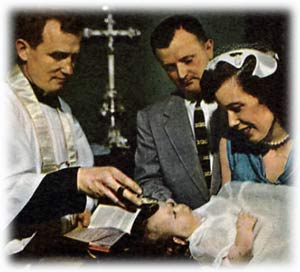
What is the formula necessary for a baptism to be considered valid in the Catholic Church? Clearly stated as in Matthew 28: 'in the name of the Father, and of the Son, and of the holy Spirit'. Seems pretty straightforward and clear-cut, doesn't it? Well of course people have taken it upon themselves to reinvent the wheel that Christ himself forged. Now the Vatican has spoken. The following quote is taken directly from the Vatican website:
QUESTIONS
First question: Whether the Baptism conferred with the formulas «I baptize you in the name of the Creator, and of the Redeemer, and of the Sanctifier» and «I baptize you in the name of the Creator, and of the Liberator, and of the Sustainer» is valid?
Second question: Whether the persons baptized with those formulas have to be baptized in forma absoluta?
RESPONSES
To the first question: Negative.
To the second question: Affirmative.
The Supreme Pontiff Benedict XVI, at the Audience granted to the undersigned Cardinal Prefect of the Congregation for the Doctrine of the Faith, approved these Responses, adopted in the Ordinary Session of the Congregation, and ordered their publication.
Rome, from the Offices of the Congregation for the Doctrine of the Faith, February 1, 2008.
William Cardinal Levada
PrefectAngelo Amato, S.D.B.
Titular Archbishop of Sila
Secretary
According to Catholic Culture:
An attached note, signed by Monsignor Antonio Miralles, professor of dogmatic theology at the Pontifical Holy Cross University, explained that the responses "concern the validity of baptism conferred with two English-language formulae within the ambit of the Catholic Church. [...] Clearly, the question does not concern English but the formula itself, which could also be expressed in another language."
"Baptism conferred in the name of the Father, the Son and the Holy Spirit," the note continued, "obeys Jesus' command as it appears at the end of the Gospel of St. Matthew. [...] The baptismal formula must be an adequate expression of Trinitarian faith, approximate formulae are unacceptable."
"Variations to the baptismal formula — using non-biblical designations of the Divine Persons — as considered in this reply, arise from so-called feminist theology," being an attempt "to avoid using the words Father and Son which are held to be chauvinistic, substituting them with other names," the note clarified. "Such variants, however, undermine faith in the Trinity."
In a commentary on the responses, Cardinal Urbano Navarrete, former rector of the Pontifical Gregorian University, clarified: "The response of the Congregation for the Doctrine of the Faith constitutes an authentic doctrinal declaration, which has wide-ranging canonical and pastoral effects. Indeed, the reply implicitly affirms that people who have been baptized, or who will in the future be baptized, with the formulae in question have, in reality, not been baptized.
"Hence, they must them be treated for all canonical and pastoral purposes with the same juridical criteria as people whom the Code of Canon Law places in the general category of 'non-baptized.'"
This implies that if they have received other sacraments, they are invalid as well and should be re-administered.
The Catholic Church recognizes most baptisms if they used the formula as noted above and if the intent is the same as what it is in the Catholic Church. The Church has spoken and the baptisms conducted within the Church of Jesus Christ of Latter Day Saints (Mormons) are invalid. Their formula is correct, but their doctrine concerning the Holy Trinity is erroneous, they do not recognize Original Sin and more. For more on the topic, click here.